How Much Does a Solar Well Pump Cost in Arizona?
A national cost guide updated in October 2026 puts solar well pump installation at $1,200 to $3,000. Its national average is $2,000. A second 2026 cost guide lists a solar pump at $1,500 to $6,500 installed. These are market numbers, not our price list.
Well depth is the biggest swing in the published numbers. In the October 2026 guide, wells of 300 to 400 feet and deeper run $3,500 to $10,000. We do solar well pump installation on ranch and stock wells and on off-grid homes around Globe.
What do published guides say a solar well pump costs?
Three national cost guides give three ranges, each with its own year. The October 2026 guide also breaks its prices out by well depth in the second table.
| Source | Year | What the number covers | Range |
|---|---|---|---|
| National cost guide | Updated October 2026 | Solar well pump installation | $1,200 to $3,000, average $2,000 |
| National cost guide | 2026 | Solar pump, average installed cost | $1,500 to $6,500 |
| National cost guide | Updated 2023 | Solar well pump | $2,000 to $4,000 |
| Well depth | Published range (2026 guide) |
|---|---|
| 0 to 150 feet | $1,200 to $2,000 |
| 150 to 300 feet | $2,500 to $3,000 |
| 300 to 400+ feet | $3,500 to $10,000 |
University of Wyoming Extension published rules of thumb for each part, which it says are valid in 2016. Read them as a 2016 parts list.
| Part | 2016 estimate (University of Wyoming Extension) |
|---|---|
| Solar panels and wiring | $1.00 to $3.00 per watt |
| Rack for the panels | $100 to $800 |
| Controller (pump and float) | $200 to $500 |
| DC pump | $500 to $2,500 |
The same bulletin put a common two-panel system, typically 400 watts, at $600 to $1,200 for panels and racking. A worked example in the next bulletin of that series came to $5,188 for the whole solar pumping system.
What goes into the price of a solar well pump system?
A solar well pump system is a handful of parts priced together. Each one grows or shrinks with your well.
The pump and controller. The pump is sized to the depth and to the gallons you need each day. The controller runs the pump off the panels.
The panels and the mount. Panel watts follow the pump. A bigger pump on a deeper well needs more panels and a stronger rack.
The float switch. A float switch at the tank tells the controller to stop when the tank is full. It is a small line on the bill.
Wire and drop pipe. Both run the full length down to the pump. Every extra foot of setting depth adds to this line.
The storage tank. The tank belongs on the same quote as the pump. We install and repair steel and poly water storage tanks for homes, ranches and livestock. Its size and material set the cost of this line.
Pipeline. Ranch water often travels from the well to a tank and on to troughs. We have laid black pipeline runs thousands of feet long, and every foot of pipe is on the bill.
Pulling the old pump. An old pump, or windmill rod and pipe, has to come out of the well first. We pull them with our own pump hoist rig, and a deeper string takes longer.
Why do well depth and lift drive the price?
Lift is how high the pump has to push water. It runs from the water level in the well up to the tank, plus friction in the pipe. Pump installers call it total dynamic head.
Wells we work run from under 100 feet along Tonto Creek to more than 700 feet in the high country. We have set solar pumps more than 700 feet down.
More lift takes a stronger pump, and a stronger pump takes more panel watts. A deep setting also takes more wire and more drop pipe.
A 2016 University of Wyoming Extension case for an 800-foot well assumed 5,400 watts of panels. Its total cost rose to $16,438, against $5,188 in its basic example. That gap is why a deep well quote looks so different.
Does solar cost less than running a power line to the well?
It can, once the nearest power is a long way off. A power line is priced by the mile, and miles add up in rough country.
In 2014, New Mexico State University Extension put a power line through rugged terrain at $10,000 to $30,000 per mile. A 2016 University of Wyoming Extension bulletin assumed $20,000 per mile and noted that it varies widely with terrain. That bulletin also compared the first cost of three ways to pump the same water.
| 2016 University of Wyoming Extension example | Initial cost |
|---|---|
| Solar pumping system | $5,188 |
| Utility connection and pump | $11,031 |
| Generator and pump | $3,428 |
The generator figure is only the starting cost. A generator burns fuel every day it runs. If a sound power line already sits close to the well, a standard electric pump may be the simpler answer.
Is the storage tank really the battery?
Yes. A solar-direct pump runs only while the sun is on the panels. University of Wyoming Extension says these systems do not require batteries. The water stored in the tank holds the energy instead.
New Mexico State University Extension says storage supplies the daily water at night or on cloudy days. The same 2014 publication sizes the tank at 3 to 10 days of water use, depending on climate and use. More days of storage means a bigger tank, and a bigger tank costs more.
How does a home well on solar compare with a stock well?
A stock well only has to fill a tank or a trough. A tank set uphill can gravity feed the troughs. On a ranch, the well, tank, pipeline and troughs get planned together as one of our livestock water systems.
A house needs water under pressure at every faucet. On an off-grid home, the solar pump fills a storage tank by day. A booster pump and a pressure tank then feed the house. A stock well skips that booster side, which adds to the cost of a home system.
USDA help for stock water is a question for your local office. Ask the NRCS field office for your county before you buy.
Can you convert a windmill well to solar?
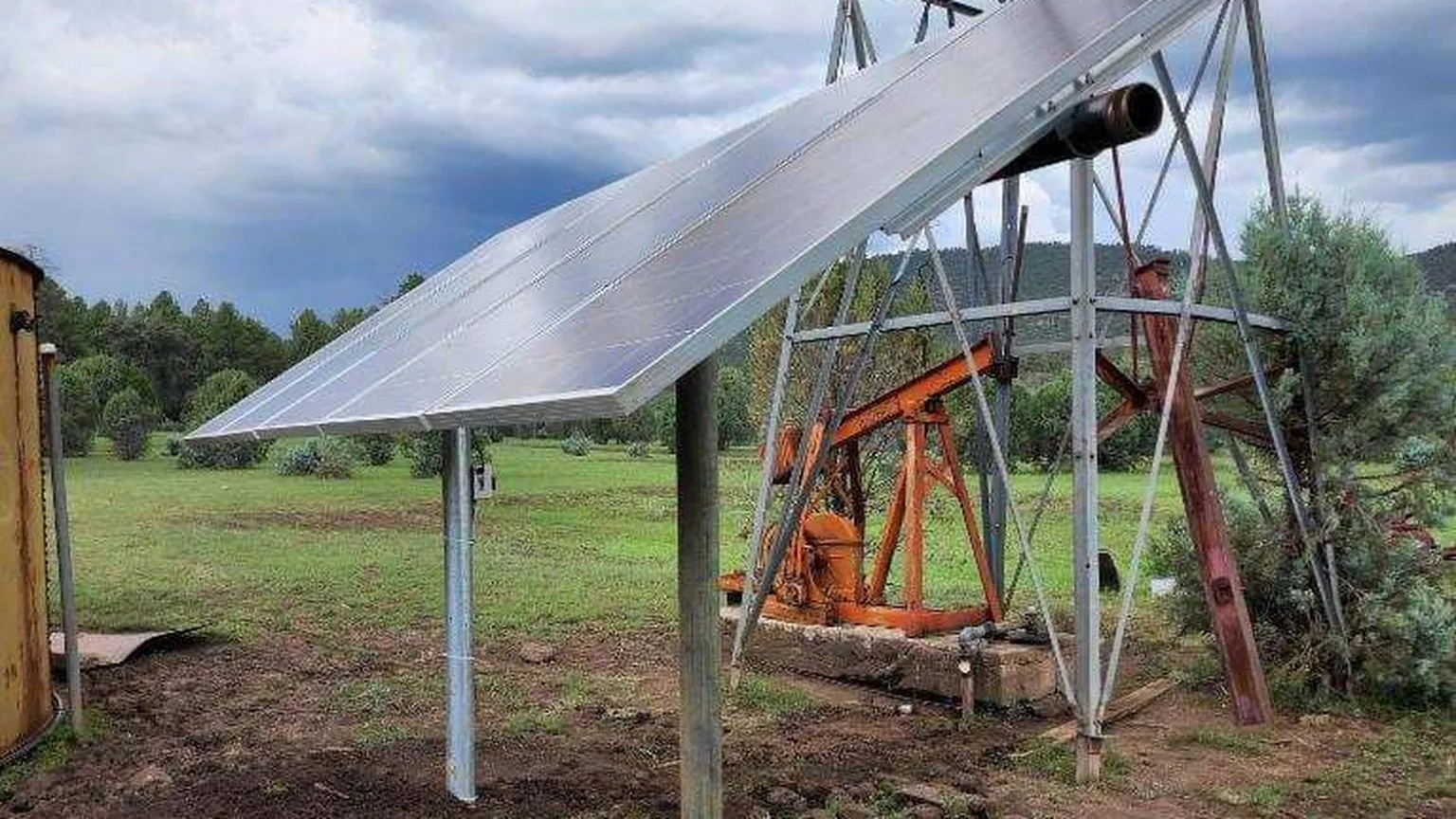
Yes. We convert windmill wells to solar pumps. The sucker rod, drop pipe and cylinder come out first, so pulling the old string is part of the cost.
If the mill and tower are sound, windmill repair may cost less than a conversion. Our solar well pump vs windmill guide covers which one fits your well.
How do we price a solar pump job around Globe?
The ranges above are national and extension figures, not a quote for your well. Your total turns on the depth, the daily gallons, the tank and the run out to it.
We ask how deep the well is and where the water stands. We also ask how many gallons a day the place uses. Then we explain the scope of work and give you a quote before work begins.
Ranch customers can also have us come through on a schedule to keep solar wells and holding tanks working. We work Gila County and the country around it, about 75 miles out from Globe. Read what our solar well pump service covers, or call or text (928) 961-6641.