No Water From the Well? What to Check Before You Call
Start with four safe checks: the well pump breaker, the pressure gauge on the tank, the light on the pump protection box, and whether the power went out or a storm worked the area overnight. None of them asks you to open anything energized. If all four come up empty, the trouble is down the well or inside a live box, and that is where well pump repair work begins.
A household well hides its problems in four places: the power feeding it, the pressure switch, the pump and pipe down the hole, and the water level. You can read the first from outside the cover and part of the second by ear. The rest takes meters and a hoist.
What Should I Check First When There Is No Water?
Go to the breaker panel and look at the well pump breaker. A submersible motor manufacturer’s service manual lists blown fuses and tripped breakers as a first cause when a motor will not start, and the University of Arizona Cooperative Extension table lists the same: power off, circuit breaker tripped, blown fuses.
Reset it once. If it trips again, leave it off and call. The Extension table ties a pump that runs a few seconds and then trips its overloads to a motor or wiring shorting to ground.
Next, read the pressure gauge on the tank and write the number down. A gauge at zero while the pump should be running points one way. Steady pressure with nothing at the tap points another, usually a closed valve or a problem past the tank. That number is the most useful thing you can give a pump company.
Then look at the pump protection box, if the system has one. These watch motor load and cut the pump off on a dry well, a blocked intake or bad line voltage. On common units a solid yellow light points at a dry well, and the manual says to wait out the restart timer while the well refills. A solid red light means line voltage under 207 volts.
On a storage tank system, check the tank first. Where a well cannot meet peak demand, Extension guidance describes adding a storage tank and a booster pump to carry the house. A stuck float or a dead booster pump empties a house while the well pump is fine, as our water storage tank work page explains.
Is It Safe to Check the Pressure Switch Myself?
Look and listen, but leave the cover on. The Extension troubleshooting table flags every electrical item with a high voltage warning, and motor manufacturers warn of voltages capable of causing severe injury or death by electrical shock. Their instructions say to disconnect power before working on the system, note that more than one disconnect switch may be needed, and warn that some controls hold lethal voltage for five minutes after power is off. A household well control runs on a 230 volt circuit, not the 120 volts of a wall outlet.
The safe version is this. Stand near the tank with the water off and listen. When tank pressure falls to the switch’s come on setting, a working switch clicks and the pump starts. A click with no pump, or no click at all, is worth writing down. Insects nesting in a switch and holding the contacts apart is common enough that the Extension lists it as a cause of a pump that will not start.
Why Is the Pump Running But No Water Comes Out?
The water level leads this list. When the pump pulls the well down faster than water flows back in, it runs and delivers little or nothing. The manufacturer’s instruction is to shut the pump off and let the well recover. A low yield well can serve a house all day and still come up short in a morning rush. Yield is the rate a well can be pumped without drawing the level below the pump intake.
Air is the other tell. If the water spits and a glass of it clouds with bubbles that rise and clear, the Extension reads that as a well pumping water and air together, the pumping level near the pump inlet. Sand and grit point the same way, and a well filled in with sediment is a well cleaning job, not a pump job.
Symptom, Likely Cause, and Who Handles It
| What you see | Likely cause | Who handles it |
|---|---|---|
| Nothing at any tap, breaker tripped | Lost power, or a motor or wire shorting to ground | Reset once; a second trip is a pump call |
| Pump will not start, gauge at zero | Contacts not closing, insects in the switch, control box fault | Pump company, power off |
| Pump runs and never shuts off | Low water level, a drop pipe leak, a worn pump | Pump company with a hoist rig |
| Storage tank empty, well pump quiet | Stuck float, failed float switch, or booster pump | Pump company |
| Nothing works after a storm | Outage, or a surge that took the motor or controls | Power company, then a pump company |
What Is Not Safe to Try
Do not open an energized control box or pressure switch. Manufacturer instructions say to kill the power first, and more than one disconnect switch may be needed.
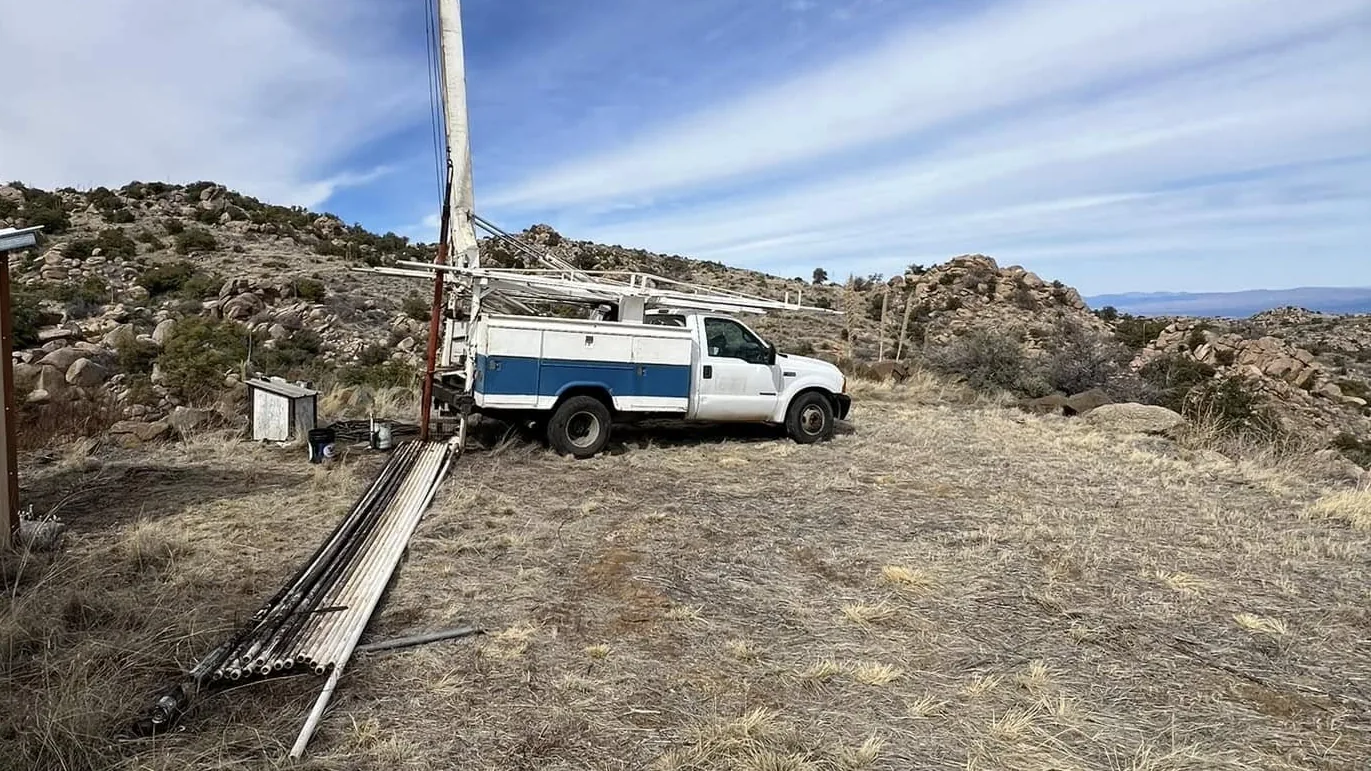
Do not try to pull the pump yourself. Extension guidance describes pump removal as rig work: a rig is set over the well, and the pump and interior plumbing come up on it. That is what our own pump hoist rig is for.
Do not pour anything down the well. Arizona Extension guidance says well owners should not try to chlorinate their own wells and should hire a qualified water well system contractor. Chlorine can mobilize naturally occurring arsenic and lead, it creates disinfection byproducts that must be flushed back out, and it damages the rubber diaphragm in a bladder pressure tank.
Could It Be a Freeze or a Monsoon Storm?
Up in the high country, a hard freeze stops water before any pump fault does. Water expands as it freezes and can crack or split a pipe, and Extension guidance notes that insulation alone will not carry a line through a long cold spell without heat or water flow. An exposed line, a switch on an unheated wall, or an open wellhead go first.
If the power blinked or lightning worked the area overnight, start with the power company. Motor manufacturers require a dedicated surge arrestor on every submersible motor for this reason, and smaller motors sometimes carry a built in one. Low line voltage alone holds a protected pump off until the line comes back up.
What Should I Tell the Pump Company When I Call?
Have these ready and the call gets shorter. What the gauge reads. Whether the breaker tripped, and whether it held. What the protection light shows. How deep the well is and how old the pump is. Whether the house runs off a storage tank and booster pump or straight off the well.
If your well sits on land under state jurisdiction, the registry number helps most. Arizona wells registered since 1980 carry a number beginning with 55 and a dash, followed by six digits, and the state files the driller’s log and the pump installation report under it. Extension guidance notes that up to date well construction and pump records are what make troubleshooting efficient. Without it, those records can still be found by the well’s location.
When the Safe Checks Come Up Empty
The next step is a meter on the electrical side, before anything comes out of the hole. Testing the pressure switch, the control box, the wire and the motor’s readings is how our water well service and repair work starts on a no water call.
Call or text Jacob’s Well and Pump Services at (928) 961-6641 and tell us what the well is doing. We are based in Globe and work Gila County and the country around it, about 75 miles out. Much of our work is where there is no cell service. If you reach voicemail, leave a message or send a text, and we call you back.